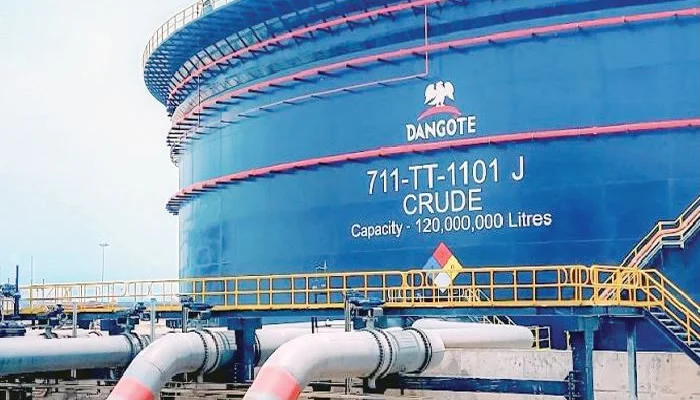
Nigeria’s fuel supply landscape is undergoing a major shift as domestic refining—led by the Dangote Refinery—now accounts for about 92 percent of the country’s petrol supply, following the Federal Government’s decision to halt import licences in 2026.
Officials at the Nigerian Midstream and Downstream Petroleum Regulatory Authority (NMDPRA) confirmed that no petrol import licences have been issued this year, citing sufficient local production to meet national demand.
“It’s correct that we’ve not issued import licences this year. Local production has met national requirements, so there’s no need for importation,” a senior official at the regulator said.
Domestic refining overtakes imports
According to the regulator’s February 2026 fact sheet, domestic refineries supplied 36.5 million litres of petrol per day, while imports contributed just three million litres daily.
This pushed total national supply for the month to 39.5 million litres per day, with local refining accounting for roughly 92 percent of the total—a sharp departure from Nigeria’s long-standing dependence on imported fuel.
The figures also show that petrol imports plunged by nearly 88 percent, dropping from 24.8 million litres per day in January to just three million litres in February.
Currently, the Dangote facility remains the only refinery producing petrol, as most modular refineries focus on refining crude into diesel.
Supply drops as imports decline
Despite the surge in domestic refining, overall petrol supply declined significantly in February due to the steep drop in imports.
The NMDPRA said total supply fell by 25.4 million litres per day compared with January’s 64.9 million litres daily.
Historically, imports have played a dominant role in Nigeria’s petrol market. For example, in December 2025, petrol imports averaged 42.2 million litres per day, compared with 32 million litres from domestic refineries, bringing total supply to 74.2 million litres daily.
Dangote refinery ramps up production
The refinery, owned by Aliko Dangote, has significantly expanded its output in recent months and says it has reached its full processing capacity of 650,000 barrels per day, supplying more than 50 million litres of petrol daily to the domestic market.
The surge in local refining is expected to reduce Nigeria’s foreign exchange demand for fuel imports and reshape the country’s downstream petroleum sector.
However, some industry stakeholders have raised concerns that the dominance of a single refinery could create monopolistic pressures in the market.
Petrol prices remain high at filling stations
Meanwhile, the refinery recently reduced its petrol gantry price by ₦100, cutting the rate from ₦1,175 to ₦1,075 per litre.
Despite the reduction, pump prices at filling stations across Lagos, Ogun State and the Federal Capital Territory remained largely unchanged, with many outlets still selling petrol between ₦1,200 and ₦1,330 per litre.
Market analysts attribute the recent volatility in fuel prices to fluctuations in global crude oil prices, which have been affected by tensions in the Middle East.
Industry groups such as the Independent Petroleum Marketers Association of Nigeria say petrol prices could stabilise once global crude prices decline further.