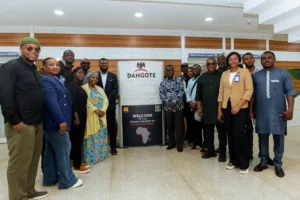
A respected Ghanaian academic has sparked playful cross-border banter after openly admitting admiration — and a touch of envy — for Nigeria’s industrial leap, following a tour of the massive Dangote Petroleum Refinery & Petrochemicals in Lagos.
Prof. Noel Tagoe, Dean of Nile Business School at Nile University of Nigeria, made the candid remark during a visit to Africa’s largest refinery, describing the facility as a transformative project not just for Nigeria, but for the entire continent.
“Seeing a world-class facility of this magnitude in Nigeria fills me with pride as an African,” he said. “But I have to be honest — as a Ghanaian, it makes me cast envious glances at Nigerians.”
The refinery, owned by industrialist Aliko Dangote, spans more than 6,000 acres and is widely regarded as one of Africa’s most ambitious private-sector infrastructure projects.
A Real-Life Classroom for African Business Leaders
Prof. Tagoe led a delegation of Executive MBA students and faculty to the facility as part of Nile Business School’s push to shift business education from theory-heavy Western case studies to practical, Africa-focused learning.
He criticized the dominance of Harvard-style American business case studies across African institutions, arguing that the continent needs homegrown examples that address its unique economic realities.
“If all we study are American case studies, the knowledge cannot fully address Africa’s unique challenges,” he said.
According to him, the refinery visit alone has already inspired at least six potential case studies for Nigeria’s oil and gas sector — proof that African success stories can and should shape business education on the continent.
Dangote: “We Bet on Nigerian Talent — And Won”
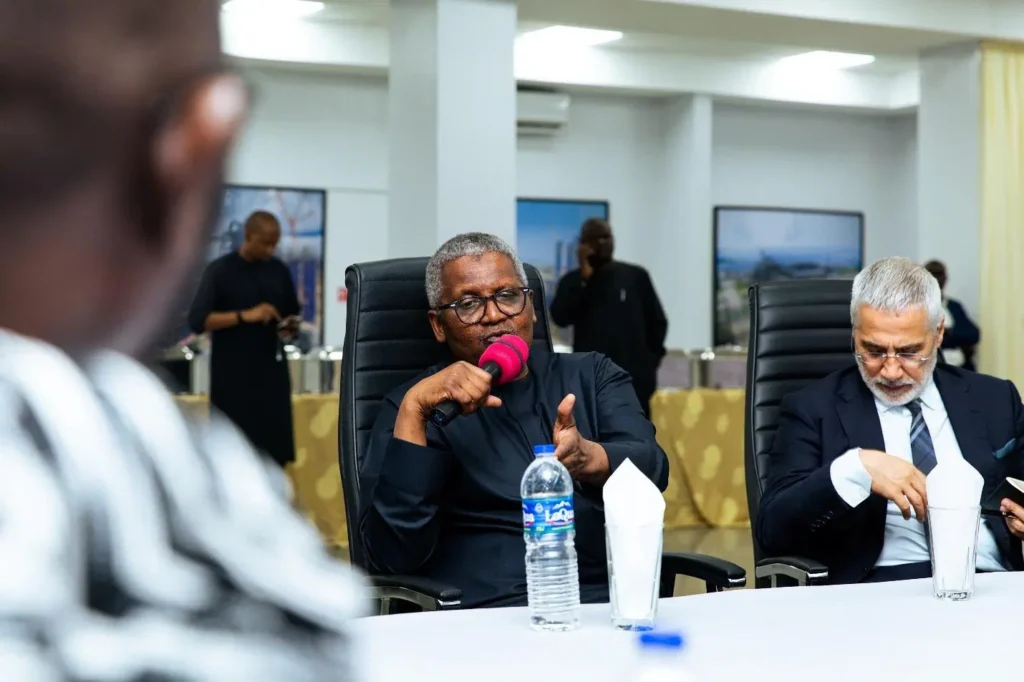
Hosting the delegation after the tour, Dangote shared insights into the refinery’s construction journey, admitting that the company initially assumed foreign engineers would dominate the project due to its scale.
That assumption proved wrong.
“When we put our Nigerian engineers alongside foreign counterparts, they performed exceptionally well,” Dangote revealed. “We ended up using significantly more Nigerians than we originally planned.”
He emphasized that many of the engineers had never studied or worked abroad, reinforcing his belief in Nigeria’s untapped human capital.
Dangote also pointed to Nigerian excellence globally — from medicine and engineering to entertainment — citing artists like Burna Boy and Davido as examples of youth talent commanding global audiences.
Beyond Government: A Private Sector Blueprint
Dangote urged students to rethink the narrative that only governments can drive development. He explained that the refinery was born out of a glaring economic gap: Nigeria exports crude oil but historically imported refined products at enormous cost.
The refinery aims to reverse that imbalance — keeping value within the country and strengthening Africa’s position in the global energy market.
He encouraged the students to identify similar “value leakage” gaps across Africa and build businesses that solve them.

A Playful Ending to a Serious Conversation
As the visit concluded, Prof. Tagoe reaffirmed his belief that Africa-focused business education is key to producing leaders capable of solving the continent’s challenges.
But before leaving Nigerian soil, he reclaimed a sliver of Ghanaian pride — with a smile:
“At least Ghana is going to the World Cup.”
The remark drew laughter — and perfectly captured the friendly rivalry between two of West Africa’s biggest powerhouses, now competing not just in football, but in industrial ambition.