
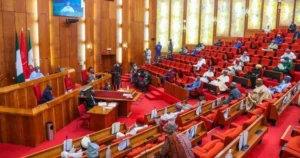
The Senate on Tuesday approved electronic transmission of election results but dropped the “real-time” requirement, following a tense and chaotic plenary session that saw sharp divisions among lawmakers over the Electoral Act Amendment Bill.
The rowdy sitting was triggered when the Senate Chief Whip, Senator Tahir Monguno (APC, Borno North), raised a point of order seeking to reverse the Senate’s earlier position on Clause 60(3) of the bill. His motion, which was seconded by Senator Abdul Ningi (PDP, Bauchi Central), called for an amendment to the clause by removing the phrase “real-time” from the provision on electronic transmission of results.
Tensions escalated in the chamber as senators exchanged shouts of “point of order,” with Senator Enyinnaya Abaribe (APGA, Abia South) challenging the procedure as Monguno moved to amend the clause. In presenting the revised provision, Monguno read Clause 60(3) with the word “transfer” replaced by “transmission,” but without the “real-time” requirement.
The original version of Clause 60(3), as contained on page 45 of the report of the Senate Committee on Electoral Matters, had mandated presiding officers to electronically transmit polling unit results to the Independent National Electoral Commission’s (INEC) Result Viewing (IREV) portal in real time, after the relevant result forms had been duly signed and stamped.
As the debate intensified, Abaribe invoked Order 72 of the Senate Standing Rules, which provides for a division and formal voting where voices are unclear. Senate President Godswill Akpabio acknowledged the point of order and noted that it amounted to a call for a division.
However, the tension eased when Abaribe later withdrew his request for a division, allowing proceedings to continue.
With the amendment adopted, the Senate ultimately retained electronic transmission of results in the Electoral Act Amendment Bill, but without specifying that such transmission must be done in real time—a decision that is likely to reignite public debate over transparency and credibility in Nigeria’s electoral process.